Daily Peace
I almost skipped sprint 5. Summer break started, the old routine didn’t fit, and with family visiting there was more variability day to day. It didn’t feel like the right time to start a new project.
But the new chaos made the need even clearer. I wasn’t spending my time fruitfully, and I couldn’t tell where it was going.
Too many systems
To live more deliberately, I’d been using several systems: the Daily Top Three (Maintain-Improve-Build), daily one-line logs grouped by month, a note for tracking workouts, ad-hoc notes for longer writing when traveling, and on top of all that, the 5 P’s I’d been working out on paper and in a couple of separate notes.
It was all over the place. I was pulled in many directions and couldn’t reconcile them into one coherent picture. I was doing some things and dropping many, and I wasn’t sure what I was dropping.
Sprint 3 gave me the framework. Sprint 4 gave me a tool for one piece of it. Sprint 5 became the attempt to hold it all together.
Starting from the 5 P’s
My first attempt was to try to fit all the systems into one. I ended up with a bland daily journal, similar to The 5 Minute Journal. I half hoped it would help me focus and half dreaded that it was adding more to my already cluttered plate. So I scrapped it. (I didn’t even take a screenshot!)
I abandoned the other systems and chose one: the 5 P’s from the Mother’s Rule. It covers the most important aspects of my entire role as a mother, so it made sense as the single foundation. Instead of designing the app first, I started from the book itself and let AI generate a first version of the app based on Pierlot’s framework.
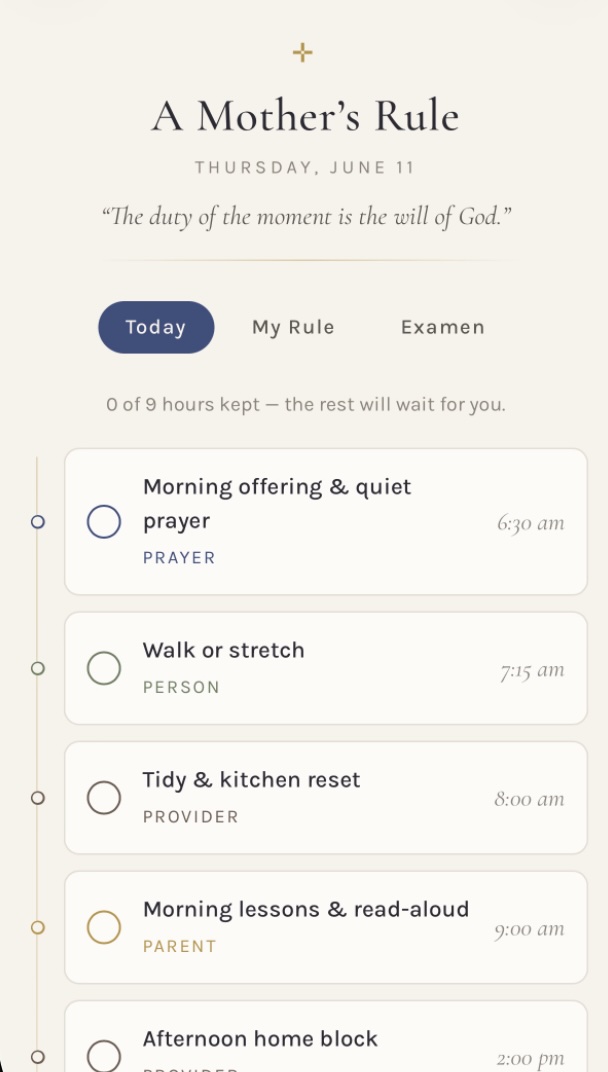
It was a pretty good start. While it didn’t flow as I would’ve liked, it had the most important backbone: My Rule, from which the day’s tasks were derived.
Having a starting point made it easier to figure out what mattered most and what was secondary, because I had something concrete to critique and improve.
Designing for intentional days
To lead an intentional life, you have to know:
- What must be done
- How long each thing will take
- When it can be done
The 5 P’s give you the big buckets (Prayer, Person, Partner, Parent, Provide). I already had a list of what I wanted to do in each. What remained was putting them on a schedule.
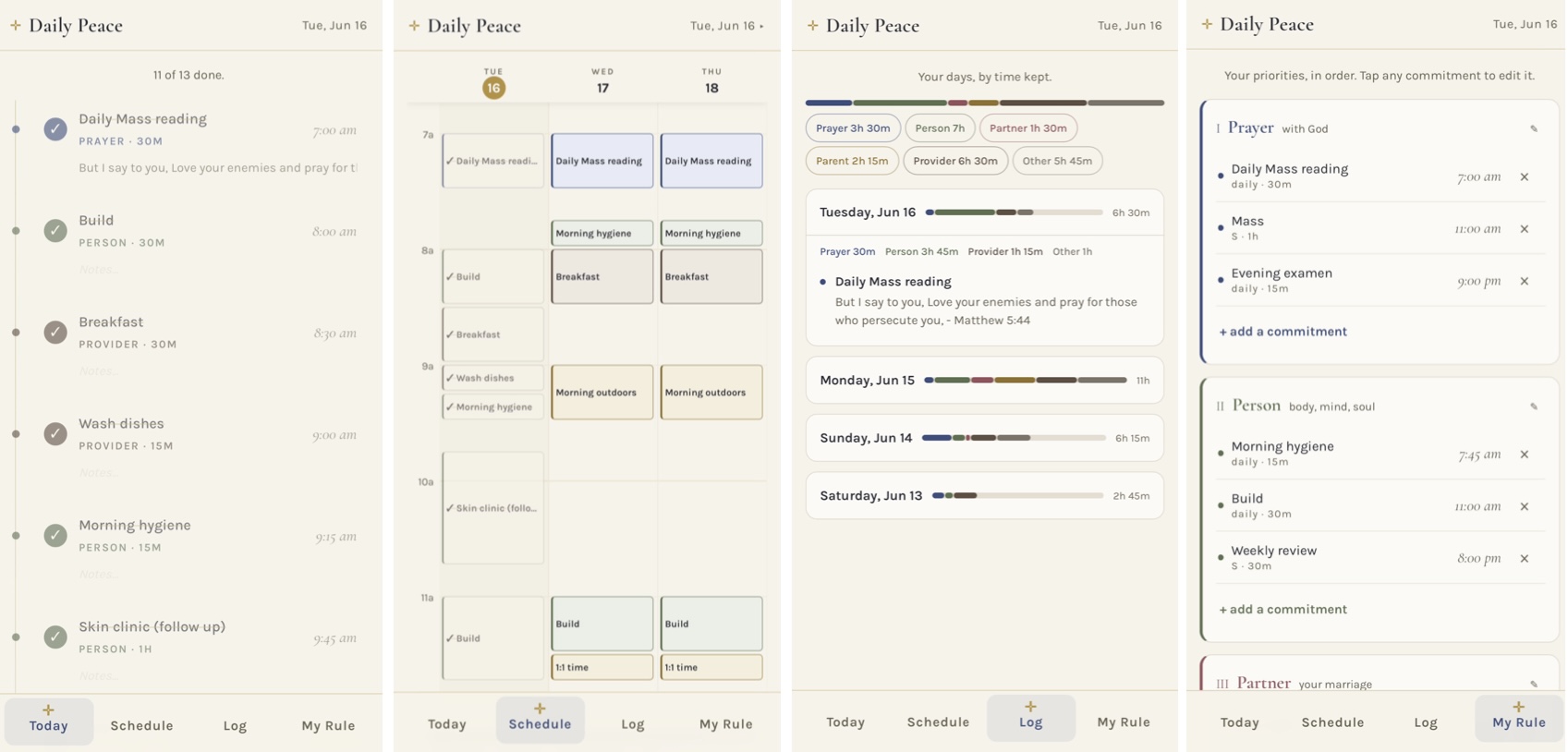
But what must be done needs to exist in the context of daily life. Not as a to-do list, but as an outline of the day. So I added a Schedule tab with 1/3/7 day calendar views.
The Rule can’t be so rigid that you follow it to the letter every day. The goal isn’t to live by the schedule but to be mindful of my priorities within the moving context of each day. So while My Rule dictates how the day is populated, I made the events editable to log what actually happened. I added a visual bar showing duration breakdown by bucket so I could see how I was dividing my time. And I added a Log tab with the summary of time spent in each bucket along with notes.
What it’s already doing
I went through many iterations beyond those initial tweaks. But even in the early days, Daily Peace has made my priorities visible. Setting time aside in the morning and afternoon to go outside with the kids actually got me outside with the kids. Adding a notes section to each commitment made me log Bible verses from my daily Mass readings. I got to sync with my partner daily for at least 15 minutes before bed.
This app is already helping me focus on what is truly important, even when I don’t feel ready to make that time.
What happened to Maintain-Improve-Build? Surprisingly, the 5 P’s made those buckets more specific and actionable because they forced me to decide what each one actually was. Maintain was mostly chores, so it went under Provide. Improve could be the relationship with my partner or kids (Partner, Parent) or a house project (Provide). Build went under Person. The 5 P’s solved the icky feeling I had on some mornings figuring out what tasks fit into which Maintain-Improve-Build bucket. So I dropped them.
The other systems (daily logs, journals, etc.) are good to have but don’t influence how I live the day, so they stay as they are with minimum intrusion. The calendar view in Daily Peace captures what I did anyway, so I can always go back and check even if I miss a day or two in the daily log.
What’s next? After carving out time for my priorities, I’m discovering that I need to find relevant activities to make the most out of that time. Perhaps a solution is another app? Stay tuned.
Check out Daily Peace.